Pages

Popular Posts

Wednesday, February 26, 2014

There are twelve traditional Jyotirlinga shrines in India.

A Jyotirlinga or Jyotirling or Jyotirlingam is a shrine where Lord Shiva, an aspect of God in Hinduism is worshipped in the form of a Jyotirlingam or "Lingam of Light."
There are twelve traditional Jyotirlinga shrines in India.


It is believed that Shiva first manifested himself as a Jyotirlinga on the night of the Aridra Nakshatra, thus the special reverence for the Jyotirlinga. There is nothing to distinguish the appearance, but it is believed that a person can see these lingas as columns of fire piercing through the earth after he reaches a higher level of spiritual attainment.

SIGNIFICANCE OF JYOTIRLINGA:

The puranas vociferously sing the praises of the greatness of the Jyotirlingas. By reciting the name of this, one can eliminate all the sins. The Sadhaka becomes calm, chaste and pure. He becomes illuminated and enlightened with supreme and divine knowledge. The names are mentioned for the benefit of all.....

Saurashtra Somanatham Cha Shrishaile Mallikarjunam...
Ujjainyam Mahakalomkare Mammaleshwaram...
Parlyam Vaijnatham Cha Dakinyam Bheem Shankaram..
Setu Bandhe Tu Ramesham Nagesham Daruka Vane...
Varanasya Tu Vishwesham Tribakam Gautamitate..
Himalaya Tu Kedaram Ghurmesham Cha Shivalaye...
Aetani Jyotirlingani Sayam Prataha Pathennaraha...
Sapta Janma Kritam Papam Smaranen Vinashyati......

One who recites these 12 names regularly in the morning and evening he washes all the sins committed in the previous 7 births and attains all the powers and Siddhis...

SHIVOHAM SHIVOHAM
 
Your appreciation Click Here if You cant see Images is our inspiration
 Click Here if You cant see Images


PLANT TREES TO SAVE ENVIRONMENT.


 VISIT BLOG &FWD TO YOUR FRIENDS
GO THROUGH THE I LAND POSTS

Tuesday, February 25, 2014

Maha Shivaratri 2014: February 27th .


Maha Shivaratri 2014: February 27th .

Millions of people will chant the mantra "OM NA MA SHI VA YA"on the night of Maha Shivaratri. These are sounds that bring the grace of Shiva, and they are also are the sounds of the five elements:
  • NA is a sound for the earth element
  • MA is a sound for the water element
  • SHI (pronounced like English word "she") is a sound for the fire element
  • VA is a sound for the air or wind element
  • YA is a sound for the ether or causal plane

Chanting these sounds on Maha Shivarati helps harmonize us with all the elements so that we are transformed into being in the right place, at the right time, doing the right thing, in the right way, with the right attitude.

Did You Know?

Bilva LeavesMany people offer bilva leaves to Shiva lingams on Maha Shivaratri. A famous devotional song called Bilvashtakam celebrates the offering of bilva patra (form of the bilva that has 3 small leaves attached to it) to Shiva and explains how this simple ritual remove negative karma.
Maha Shivaratri 2014

Shivaratri is great festival of convergence of Shiva and Shakti. Chaturdashi Tithi during Krishna Paksha in month of Magha is known as Maha Shivaratri according to South Indian calendar. However according to North Indian calendar Masik Shivaratri in month of Phalguna is known as Maha Shivaratri. In both calendars it is naming convention of lunar month which differs. However both, North Indians and South Indians, celebrate Maha Shivaratri on same day. 
Vrat Vidhi – One day before Shivaratri Vratam, most likely on Trayodashi, devotees should eat only one time. On Shivaratri day, after finishing morning rituals devotees should take Sankalp (संकल्प) to observer full day fast on Shivaratri and to take food next day. During Sankalp devotees pledge for self-determination throughout the fasting period and seek blessing of Lord Shiva to finish the fast without any interference. Hindu fasts are strict and people pledge for self-determination and seek God blessing before starting them to finish them successfully. 

On Shivaratri day devotees should take second bath in the evening before doing Shiva Puja or visiting temple. Shiva Puja should be done during night and devotees should break the fast next day after taking bath. Devotees should break the fast between sunrise and before the end of Chaturdashi Tithi to get maximum benefit of the Vrat. According to one contradictory opinion devotees should break the fast only when Chaturdashi Tithi gets over. But it is believed that both Shiva Puja and Parana (पारणा) i.e. breaking the fast should be done within Chaturdashi Tithi. 

Shivaratri puja can be performed one time or four times during the night. The whole night duration can be divided into four to get four Prahar (प्रहर) to perform Shiva Puja four times. Drikpanchang.com lists all four Prahar durations for staunch Shiva devotees who perform Shiva Pujan four times in the night. We also list Nishita time when Lord Shiva appeared on the Earth in the form of Linga and the time window to break the fast on next day. 

Shivaratri is also spelled as Shivratri, Shivarathri and Sivaratri. 

“OMNAMAHSHIVAYA”

Visit Us @ www.MumbaiHangOut.OrgVisit Us @ www.MumbaiHangOut.Org Visit Us @ www.MumbaiHangOut.OrgVisit Us @ www.MumbaiHangOut.Org
Visit Us @ www.MumbaiHangOut.OrgVisit Us @ www.MumbaiHangOut.Org

Mahashivaratri Festival

Mahashivaratri Festival or the ‘The Night of Shiva’ is celebrated with devotion and religious fervor in honor of Lord Shiva, one of the deities of Hindu Trinity. Shivaratri falls on the moonless 14th night of the new moon in the Hindu month of Phalgun, which corresponds to the month of February - March in English Calendar. Celebrating the festival of Shivaratri devotees observe day and night fast and perform ritual worship of Shiva Lingam to appease Lord Shiva.

When is Shivaratri?Maha Shivaratri 2014: February 27th .

Auspicious festival of Mahashivaratri falls on the 13th or the 14th night of the new moon during Krishna Paksha in the Hindu month of Phalgun. The Sanskrit term, Krishna Paksha means the period of waning moon or the dark fortnight and Phalguna corresponds to the month of February - March in English Calendar. Shivaratri Festival is celebrated on a moonless night. According to Hindu mythology, Shivaratri or 'Shiva's Great Night' symbolizes the wedding day of Lord Shiva and Parvati. Many however, believe, Shivaratri is the night when Lord Shiva performed the Tandava Nritya - the dance of primordial creation, preservation and destruction. Celebrating the festival in a customary manner, devotees give a ritual bath to the Lingam with the panchagavya - milk, sour milk, urine, butter and dung. Celebrations of Shivaratri Festival mainly take place at night. Devotees of Lord Shiva throng Shiva temples across the country and spend ‘the Night of Lord Shiva’ by chanting verses and hymns in praise of the Lord. The festival holds special meaning for the ladies. They pray to Goddess Parvati also called 'Gaura', the giver of 'suhag' for good husbands, marital bliss and a long and prosperous married life. Significance of Shivaratri in Hinduism Festival of Mahashivaratri has tremendous significance in Hinduism. According to sacred scriptures, ritual worship of Lord Shiva on Shivratri festival that falls on the 14th day of the dark fortnight in the month of Phalgun pleases Lord Shiva the most. This fact is said to have been declared by Lord Shiva himself, when his consort Parvati asked him as to which ritual performed by his devotees pleases him the most. Even till date, devotees of Lord Shiva perform the ritual worship of Shivratri with care and devotion. They observe day and nigh fast and give sacred bath to Shiva Linga with honey, milk, water etc. Hindus consider it extremely auspicious to worship Lord Shiva on a Shivaratri as it is believed that worship of Lord Shiva with devotion and sincerity absolves a devotee of past sins. The devotee reaches the abode of Lord Shanker and lives there happily. He is also liberated from the cycle of birth and death and attains moksha or salvation. Significance of Shivaratri for Women Mahashivratri Festival is also considered to be an extremely significant festival by women. Married and unmarried women observe fast and perform Shiva Puja with sincerity to appease Goddess Parvati who is also regarded as ‘Gauri’ - one who bestows marital bliss and long and prosperous married life. Unmarried women also pray for a husband like Lord Shiva who is regarded as the ideal husband. 


< /tr>
Mahashivaratri Mantras
Maha Mrityunjay Mantra
One of the ancient Sanskrit mantras, Maha Mrityunjaya Mantra is a verse of Yajurveda. It is the great death-conquering mantra, which is popularly referred to as Tryambakam Mantra, as it is identified with the three-eyed Hindu deity - Lord Shiva. The Mantra has many names and forms. It is sometimes called the Rudra Mantra, with reference to the furious face of Lord Shiva. On the other hand, when it is called the Tryambakam Mantra, then it is referred to the alluding three eyes of Lord Shiva. When it comes to life, it is Mrityunjaya Mantra is called the Mrita-Sanjivini Mantra. 

Mrityunjaya Mantra holds the highest place among the Sanskrit mantras used for meditation. The recital of Mrityunjaya Mantra is beneficial for the body and soul in many ways. According to Yajurveda, if the mantra is chanted with immense concentration and devotion, then it purifies the karmas of the soul. Mental, emotional and physical health can be improvised by the regular chanting of Maha Mrityunjaya Mantra. In the following lines, we have provided the Mrityunjaya Mantra. 

Mrityunjaya Mantra 
Om Tryambakam Yajamahe Sugandhim Pushtivardhanam Urvarukamiva Bandhanan Mrityor Mukshiya Maamritat 

English Translation 
"OM. We worship and adore you, O three-eyed one, O Shiva. You are sweet gladness, the fragrance of life, who nourishes us, restores our health, and causes us to thrive. As, in due time, the stem of the cucumber weakens, and the gourd is freed from the vine, so free us from attachment and death, and do not withhold immortality." - by Arthur Berriedale Keith 

Word By Word Translation 
Tri-ambaka-m - The three-eyed-one Yaja-mahe - We praise Sugandhi-m - The fragrant Pusti-vardhana-m - The prosperity-increaser Urvaruka-m - Disease, attachment, obstacles in life, and resulting depression” iva “-like Bandhanat - From attachment Stem (of the gourd); but more generally, unhealthy attachment Mrtyor - From death Mukshiya - May you liberate Ma - Not Amritat - Realization of immortality


Mahashivaratri Significance
Mahashivaratri is one of the important Hindu festivals celebrated with religious fervor across the length and breadth of India. Followers of Lord Shiva consider the festival very special, as it is the time to show their love and devotion to their favorite deity. It is significant in every devotee's life, as it also tests ones ability to abstain from food (because fast is observed on the day) and remain vigil in the night without sleeping (because one has to remain awake all through the night, on Mahashivratri). In addition to this, Maha Shivaratri bears significance in Hindu mythology. In the following lines, learn all about the significance of Mahashivaratri. 

Significance Of Maha Shivratri 

Importance In Hinduism 
According to the Hindu mythology, Lord Shiva declared that the rituals performed by his devotees on the 14th day of the dark fortnight in the month of Phalgun please him the most. Therefore, year by year, the day is observed as Mahashivratri, wherein devotees observe fast, sing songs and bhajans and offer prayers to the Almighty to seek his blessings. Pujas conducted in Lord Shiva temples during the day have significance too. This is because the rituals are conducted strictly in accordance with the method that is prescribed in Shiva Purana, a Hindu epic. According to the Purana, poojas are conducted once in every three hours, on Maha Shivaratri. 

Importance In Human Lives 
It is believed that the devotion of Lord Shiva on Mahashivaratri would freed the devotee from the past sins. Moreover, the devotee would reach the adobe of Lord Shiva and live there happily, because he/she is liberated from the cycle of birth and death, once he/she attains moksha or salvation. Therefore, all the devotees of Lord Shiva would flock the temples to offer their prayers. To serve the purpose, jujube fruits, stalks of Bilwa leaves, flowers and garlands are offered to the Shiva Linga by the devotees. If the devotee celebrates the festival at home, he/she would perform the Mahashivratri Puja by taking a holy bath (in warm water) early in the morning, wearing new clothes and then smearing bhasm (holy ash) on their forehead. 

Importance For Women 
Maha Shivaratri is especially important for women. Ladies, both married and unmarried, would perform Shiva Puja and observe fast with great devotion and sincerity. This is predominantly done to appease Lord Shiva along with his consort Goddess Parvati, who is often called Ma Gauri. It is believed that Ma Gauri bestows marital bliss on unmarried women and blesses the married women with healthy and blissful married life. Since Lord Shiva is regarded as the ideal husband by the Hindu women, the unmarried women would not miss to observe the stringent fast on Shivaratri.


“OM NAMAH SHIVAYA”
    
Your appreciation Click Here if You cant see Images is our inspiration
 

 VISIT BLOG &FWD TO YOUR FRIENDS
GO THROUGH THE I LAND POSTS

Saturday, February 22, 2014

You can Look at Tomorrow. Today ??? Really !!! This is NO Joke


Check this out …. 
Looking at Tomorrow 
This is Interesting…

cid:image001.jpg@01CF2D82.985BB8A0

 Above photo shows two islands in sea facing each other silently. 
These are not ordinary islands. They are located in Bering Straits. 
They belong to two Super Powers - Russia and USA and represent two different days of calendar at any given time. 
They are just 2.4 km apart from each other. 
 
The bigger one called Big Diomede with an area of 29 km2 with no population, 
belongs to Russia and part of Siberia - 25 km from main land. 
International Date Line is about 1.8 km east of this island 
 
The smaller one is called Little Diomede with an area 7.3 km2 with a population of 170, belongs to Alaska - 25 km from main land 
International Date Line is about 0.6 km west of this island. 
 
On a clear day, by looking at Big Diomede from Little Diomede - 
one can see tomorrow as the time difference between the two islands is exactly 24 hrs. 
Very Interesting.
It reminds one of the joke; 

"The world cannot end today, it is already tomorrow in Australia"

  
Close up Satellite View of both islands 
 
cid:image002.jpg@01CF2D82.985BB8A0


Sattelite view of Bering Straits - Siberia is towards left  & Alaska is in on right side. 
 
cid:image003.jpg@01CF2D82.985BB8A0
cid:image004.jpg@01CF2D82.985BB8A0
 
 
Many Russians and even Americans may not be aware of these facts as these islands are quite far away from them.
 
 cid:image005.jpg@01CF2D82.985BB8A0

Visit Us @ www.MumbaiHangOut.Org
      
Your appreciation Click Here if You cant see Images is our inspiration
 Click Here if You cant see Images


PLANT TREES TO SAVE ENVIRONMENT.


 VISIT BLOG &FWD TO YOUR FRIENDS
GO THROUGH THE I LAND POSTS

RAMNATH

Wednesday, February 12, 2014

Some of the Most Beautiful Temples of the World !!

Some of the Most Beautiful Temples of the World !!

Here is a listing of some of the beautiful temples of the World !! 
It Includes the Harmandir Sahib in Amritsar, Taktshang in Bhutan, Wat Rong Khun in Thailand, Prambanan in Indonesia, Shwedagon Pagoda in Burma, Temple of Heaven in Beijing, Chion-in in Japan, Sri Ranganathaswamy Temple in Tamil Nadu & the Angkor Wat in Cambodia.
 
 
Taktshang
 
 
BeautifulTemples

BeautifulTemples 
Taktshang is the most famous of monasteries in Bhutan. 
It hangs on a cliff at 3,120 metres (10,200 feet), some 700 meters (2,300 feet) above the bottom of Paro valley, some 10 km from the district town of Paro. 
Famous visitors include Shabdrung Ngawang Namgyal in the 17th century and Milarepa.
The name means "Tiger's nest", the legend being that Padmasambhava (Guru Rinpoche) flew there on the back of a tiger. 
The monastery includes seven temples which can all be visited. 
The monastery suffered several blazes and is a recent restoration. 
Climbing to the monastery is on foot or mule.
 
 
Wat Rong Khun
 
 
BeautifulTemples
BeautifulTemples 
Wat Rong Khun is a contemporary unconventional buddhist temple in Chiang Rai, Thailand. 
It was designed by Chalermchai Kositpipat. Construction began in 1998 and is expected to end in 2008.
Wat Rong Khun is different from any other temple in Thailand, as its ubosot (Pali: uposatha; consecrated assembly hall) is designed in white color with some use of white glass. 
The white color stands for Lord Buddha’s purity; the white glass stands for Lord Buddha’s wisdom that "shines brightly all over the Earth and the Universe."
 
 
Prambanan
 
 
BeautifulTemples
BeautifulTemples 
Prambanan is the largest Hindu temple compound in Central Java in Indonesia, located approximately 18 km east of Yogyakarta. 
The temple is a UNESCO World Heritage Site and is one of the largest Hindu temples in south-east Asia. 
It is characterised by its tall and pointed architecture, typical of Hindu temple architecture, and by the 47m high central building inside a large complex of individual temples.
 
 
Shwedagon Pagoda
 
 
BeautifulTemples
BeautifulTemples 
The Shwedagon Pagoda also known as the Golden Pagoda, is a 98-metre (approx. 321.5 feet) gilded stupa located in Yangon, Burma. 
The pagoda lies to the west of Kandawgyi Lake, on Singuttara Hill, thus dominating the skyline of the city. 
It is the most sacred Buddhist pagoda for the Burmese with relics of the past four Buddhas enshrined within, namely the staff of Kakusandha, the water filter of Konagamana, a piece of the robe of Kassapa and eight hairs of Gautama, the historical Buddha.
 
 
Temple of Heaven
 
 
BeautifulTemples
BeautifulTemples 
The Temple of Heaven, literally the Altar of Heaven is a complex of Taoist buildings situated in southeastern urban Beijing, in Xuanwu District. 
The complex was visited by the Emperors of the Ming and Qing dynasties for annual ceremonies of prayer to Heaven for good harvest. 
It is regarded as a Taoist temple, although Chinese Heaven worship, especially by the reigning monarch of the day, pre-dates Taoism.
 
 
Chion-in
 
 
BeautifulTemples
BeautifulTemples 
Chion'in Temple in Higashiyama-ku, Kyoto, Japan is the headquarters of the Jodo Shu (Pure Land Sect) founded by Honen (1133-1212), who proclaimed that sentient beings are reborn in Amida Buddha's Western Paradise (Pure Land) by reciting the nembutsu, Amida Buddha's name.
The vast compounds of Chion-in include the site where Honen settled to disseminate his teachings and the site where he died.
 
 
Harmandir Sahib
 
 
BeautifulTemples
BeautifulTemples 
Sri Harmandir Sahib or Darbar Sahib, informally referred to as The Golden Temple or Temple of God, is culturally the most significant place of worship of the Sikhs and one of the oldest Sikh gurdwaras. 
It is located in the city of Amritsar, which was established by Guru Ram Das, the fourth guru of the Sikhs and the city that it was built in, is also due to the shrine, known as "Guru Di Nagri" meaning city of the Sikh Guru.
 
 
Sri Ranganathaswamy Temple
 
(Srirangam)
 
 
BeautifulTemples
BeautifulTemples 
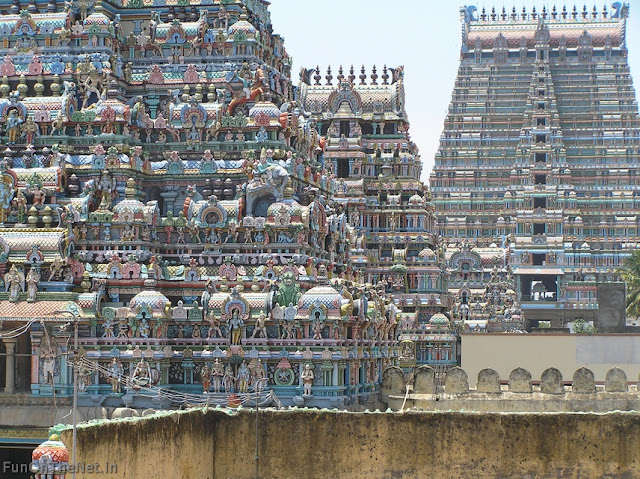
The temple occupies an area of 156 acres (6,31,000 m²) with a perimeter of 1,116m (10,710 feet) making it the largest temple in India and one of the largest religious complexes in the world. 
In fact, Srirangam temple can be easily termed as the largest functioning Hindu temple in the world (Angkor Wat being the largest non-functioning temple). 
The temple is enclosed by 7 concentric walls with a total length of 32,592 feet or over six miles. 
These walls are enclosed by 21 Gopurams (Towers). 
Among the marvels of the temple is a "hall of 1000 pillars" (actually 953).
 
 
Angkor Wat
 
 
BeautifulTemples
BeautifulTemples 
Angkor Wat (or Angkor Vat), is a temple complex at Angkor, Cambodia, built for King Suryavarman II in the early 12th century as his state temple and capital city. 
As the best-preserved temple at the site, it is the only one to have remained a significant religious centre since its foundation—first Hindu, dedicated to Vishnu, then Buddhist. 
The temple is the epitome of the high classical style of Khmer architecture. 
It has become a symbol of Cambodia, appearing on its national flag, and it is the country's prime attraction for visitors.

Your appreciation Click Here if You cant see Images is our inspiration
 Click Here if You cant see Images


PLANT TREES TO SAVE ENVIRONMENT.


 VISIT BLOG &FWD TO YOUR FRIENDS
GO THROUGH THE I LAND POSTS

RAMNATH